

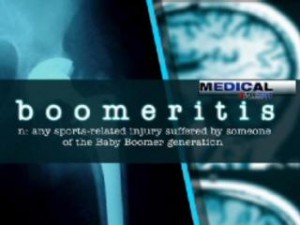
 Boomeritis® is my term for recognition of the wear, tear, vulnerabilities and injuries that most of us have or will develop with our musculoskeletal system, our frame.
I coined the term Boomeritis as a response to several observations in my personal and professional life and have developed educational seminars and programs to prevent many of these issues that too many of us face. I have always been committed to exercise and fitness and I workout regularly. I began to notice that I could not go to the gym without several people coming up to me to ask questions about their aches and pains.
I found the same questions about the same ailments being asked over and over. That is one of the downsides to being a pretty well-known, reasonably accessible, sports medicine specialist and orthopedic surgeon.
Around the same time, in my private practice, I was seeing a tremendous increase in musculoskeletal symptoms, ailments, and injuries in active individuals.
Most, but not all of the afflicted, both at the gym and office, were like me, born between the years 1946 and 1964 and were baby boomers.
I began to use the word “Boomeritis” with these patients, fellow exercisers, and the media to describe the tendinitis, bursitis, arthritis, and most importantly, “Fix-Me-Itis” that I was seeing on a regular basis and the term stuck. A new epidemic was born. TV, radio, print and internet covered “Boomeritis” extensively and I believe it is here to stay
First I spoke of “Boomeritis” in jest, having some fun with my generation, the boomers, but the more I thought about it, the more I felt that I was on to something new conceptually, something that would be around for a long time. I was actually prompted to think deeper about this by Claudia Kalb for her story “The Jock vs. The Clock” for Newsweek Magazine. It was a wonderful article that paved the road for the many to follow and although she never used my term “Boomeritis”, a new word was born.
Boomeritis is a new phenomenon because the baby boomers are the first generation that is trying to stay active, in droves, on an aging frame. Fitness and activity are important keys to healthy aging. Certainly, there were a few enlightened individuals before the boomers who adopted the active lifestyle, but in general, prior generations did not. My parents, for example, rarely if ever did planned exercise. If they tried something and were sore the following day, they would never go back to that activity again.
Things have also changed in other ways. At the turn of the last century (Circa 1900) the average life expectancy was only 46. We are now living into our late 70’s and even 80’s in some countries.
 Although we have extended our life span, we have not extended the warranty on our frame or musculoskeletal system and things break down.
Various tissues, bone, tendon, muscle, spinal discs, etc. go through predictable wear and degeneration with aging. It’s like gray hairs and wrinkles, we all get them. Many of these changes occur under the radar, without any symptoms.
Add to this old injury, planned overuse, and the “no pain, no gain” mindset and you have vulnerable parts, and orthopedic waiting rooms and OR’s filled with these individuals.
Although boomers were the first to emerge with “Boomeritis” in large numbers, future generations, X, Y, and whatever will continue to live longer and have to contend with bones and joints that were not designed to go that distance, and parts are not always easy to get.
Too little exercise, or too much can get you into trouble and I believe there are tremendous things we can do to both live longer and live stronger. Although tissue changes are inevitable, problems are not.
The solution lies in learning to listen to your body and seek expert help when things start to go sometimes even before (preventive maintenance).
From a prevention standpoint, good nutrition and the right dose of balanced smart exercise go a long way toward a healthy frame.
If problems arise with your exercise program you need to be able to safely modify it or change it to allow you to keep going. The human body was built to move and does not do well when placed on the shelf.
Sedentary behavior, all too common in this modern world, is not an option- it’s as dangerous for your health as smoking a pack of cigarettes a day. To ensure a strong frame, proper rehabilitation of old nagging injuries or chronic ailments is key.
Also the present and future have never been brighter if you need to come into the repair shop for surgical repair. What I am talking about is creating a durable frame that can, and will go the distance.